

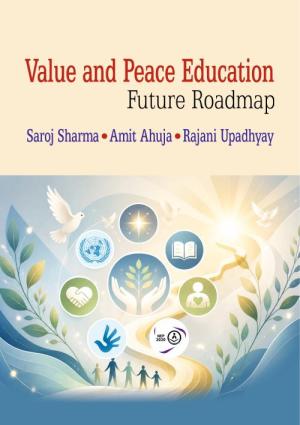

The book explores the vital role of values and peace in shaping responsible, compassionate, and ethically grounded individuals. In an era marked by rapid technological advancements, social transformation, and increasing global challenges, it highlights the urgent need to integrate value-based and peace-oriented learning into mainstream education.
The book presents a balanced blend of theoretical foundations and practical approaches to value education, moral development, human rights education, peace education, and sustainable development. Drawing upon Indian cultural traditions, constitutional values, and the vision of NEP 2020, it offers meaningful insights into fostering empathy, integrity, social responsibility, and global harmony.
Designed for students, teacher educators, researchers, policymakers, and practitioners, this volume serves as a valuable resource for promoting holistic education and nurturing a more peaceful, inclusive, and compassionate society.
Prof. Saroj Sharma is a prominent academic leader in the field of education in India and a Professor at the University School of Education, Guru Gobind Singh Indraprastha University, New Delhi. She is currently serving as the Vice Chancellor of Ranchi University. With extensive experience in academic leadership, curriculum development, research supervision, and national educational initiatives, she has played a pivotal role in strengthening education in India.
Prof. Amit Ahuja is a faculty at the University School of Education, Guru Gobind Singh Indraprastha University, New Delhi. A recipient of the 32nd Dr. S. Radhakrishnan Memorial National Teacher Award (2016) and Council for Teachers’ Professional Development, India Fellowship Award-2023. He specializes in Methodology of Educational Research, Educational Technology, Cognitive Psychology, Science Education, Educational & Vocational Guidance and Social & Adult Education.
Dr. Rajani Upadhyay, former Assistant Professor at the Amity Institute of Education, New Delhi, has nearly a decade of experience in education. Her areas of expertise include Educational & Cognitive Psychology, Science Education, Educational Research Methodology & Statistics, Guidance & Counselling and Educational Technology. She has been actively engaged in research and academic initiatives, authored academic publications, and contributed extensively to education and e-contents creation.
Preface
CHAPTER 1
Conceptual Understanding of Value/ 1
Introduction / 1; Malaise within Indian Culture / 1; Concept of Value / 4; Perspectives of Value / 9; Classification of Value / 12; Theories of Value / 14; Inherent Problems in Acquiring Values / 18; Rationale for Why Values are Being Eroded / 21; Importance of Value in the Educational Systems in Ancient India / 22; Science of Living / 23; Conceptual Understanding of Value as per NEP 2020 / 25
CHAPTER 2
An Introduction to Value Education/ 27
Introduction / 27; Meaning of Value Education / 27; Relationship between Education and Value Education / 29; Aims and Objectives of Value Education / 30; Importance of Value-Based Education in the 21st Century / 31; How to Acquire Values Education / 35; Imparting Values through Education / 37; Teacher’s Role in Inculcating Value Education / 38; Historical Background on Value Education / 39; Views on Value Education—Indian and Western / 42; Global Trends of Value Education / 48; Value Education as per NEP 2020 / 49
CHAPTER 3
Concept of Morality, Moral Education, and Moral Development/ 51
Introduction / 51; Moral Education Versus Religious Education / 52; Difference between Moral Education, Moral Instruction, and Moral Training / 53; Criteria for Making Moral Judgments / 54; Who are Morally Educated Individuals? / 55; Parental Education as Natural Moral Education / 56; Concept of Morality / 57; Introduction to Moral Development / 66; Educational Implications of Moral Development / 67; Theories of Value Development / 72; Morality and Moral Education as per NEP 2020 / 79
CHAPTER 4
Fostering Value Education/ 81
Introduction / 81; Development of Values: Attitudes and Personal Qualities / 81; Core Values / 82; Values-Inculcating Function of Schools: A Look at Several Approaches / 82; Ways of Fostering Values in Children / 83; Rath’s Process of Valuing / 91; Methods of Fostering Values / 92; Strategy to Improve Values Education in Schools / 93; Fostering Value Education as per NEP 2020 / 100
CHAPTER 5
Value Crisis and Response to Value Crisis/ 101
Introduction / 101; Value Crisis / 101; Values Crisis in India / 105; Value Crisis in Education / 107; Reason behind the Decline of Values / 111; Value-Based Education—A Remedy for Reducing Criminal Activity / 111; Gandhian Formula: “Be the Change You Wish to See in the World” / 114; Addressing the Value Crisis as per NEP 2020 / 116
CHAPTER 6
Value Development and Agents of Socialization/ 117
Introduction / 117; Values Education and Its Importance / 117; Period of Value Development / 118; Socialization: As Process for Value Development / 118; Agents of Socialization and its Impact on Value Development / 122; Value Development and Socialization as per NEP 2020 / 150
CHAPTER 7
Value Development through Curriculum/ 152
Introduction / 152; Value Models / 152; Value Identification / 157; Value Integration / 159; Value Transaction / 166; Integrating Values into the Curriculum as per NEP 2020 / 171
CHAPTER 8
Value and Co-Curricular Activities/ 172
Introduction / 172; Organisation of Co-Curricular Activities / 172; Values and Co-Curricular Activities / 180; Co-Curricular Activities as a Means of Reinforcing Core Curriculum Values / 187; Co-Curricular Activities and Holistic Development as per NEP 2020 / 196
CHAPTER 9
ICT and Value Development/ 197
Introduction / 197; ICT Across the Curriculum / 197; Cultural, Social, and Professional Impact of ICT / 198; Integrating ICT into Value-Based Education / 198; Values and Present-Day Actualities / 203; ICT in Value Education as per NEP 2020 / 205
CHAPTER 10
Indian Culture and Values for Sustainable Development/ 207
Introduction / 207; Culture / 207; Values Underlying Indian Culture / 208; Values Enshrined in the Constitution of India / 212; Importance of Culture in the Classroom— A Quality Schooling / 215; Cultivation of Respect for Different Types of Values / 216; Values for Sustainable Development / 217; Role of Children in Sustainable Development / 220; Indian Culture and Values as per NEP 2020 / 224; Conclusion / 224
CHAPTER 11
Human Rights Education/ 225
Introduction / 225; Meaning of Human Rights Education / 225; Human Rights and Education / 230; National Human Rights Commission and its Role / 233; The Indian Constitution and Human Rights / 234; United Nations Decade for Human Rights Education (1995-2004) / 238; Plan of Action for the United Nations Decade for Human Rights Education, 1995-2004 / 238; Curriculum Development for Human Rights Education / 240; Human Rights Education through Co-Scholastic Activities / 246
CHAPTER 12
Peace Education/ 248
Introduction / 248; Aims of Peace Education / 248; Basics of Peace Education / 251; Education for Culture of Peace and Non-Violence / 259; Peace Education and Teacher / 263; Pedagogies for Peace / 268; Techniques of Peace Education / 269; Human Rights Education and Peace Education as per NEP 2020 / 276
CHAPTER 13
Peace Education in Theory and Practice/ 277
Introduction / 277; Historical Development of Peace Education / 277; Peace Education in India and its Development / 280; Gandhiji’s Contributions to the Peace Movement / 280; Peace Initiatives / 283; Vinoba Bhave (1895-1982)/ 283; Jayprakash Narayan (1902-1979) / 285; Martin Luther King (1929-1968) / 286; Nelson Mandela (1918-2013) / 288; Gene Sharp (1928-2018) / 289; Integrating Peace Education in the Curriculum / 290; Teaching Methods / 291; Pedagogy of Education of Peace / 295
CHAPTER 14
Concept of World Peace/ 300
Introduction / 300; Origin, Meaning, and Concept of World Peace / 300; Principles and Methods of World Peace / 301; Role of International Planning Policies and Procedures in Securing World Peace / 302; Relevance of World Peace / 304; International Organisations for World Peace / 305; Concept of World Peace in Indian Perspective / 316; World Peace as per NEP 2020 / 320
Appendix Value Education Based on NEP 2020